Grounding Techniques – What Works?

Grounding Techniques for Calm, Emotional Balance
When life feels overwhelming, or you’re worried or anxious, grounding is one of the simplest yet effective ways to support you and bring back a sense of calm.
Grounding techniques work by gently interrupting the spiral and racing thoughts, and bringing your attention back to the present moment. They help by creating a pause where you can slow things down and notice what’s happening.
A brief interruption allows you to think more logically and refocus. As your brain calms, the physical reactions (racing heart, rapid breathing, etc.) also begin to slow, bringing you back to a steady space.
In this blog, we look at different grounding techniques, along with some prompts to help you reset your thinking and maintain the sense of calm.
*Affiliate Disclosure: Some links in this post may contain affiliate links. If you purchase something via the link, I may receive a small commission. This doesn’t affect the price you pay.
If you have any questions, reach out for a chat at info@quietlyconquer.com or check out my other blogs
Table of Contents
What Does Grounding Mean?
Grounding is a term used to describe techniques that are used to bring your attention back to the present moment when you are feeling anxious, overwhelmed, or triggered and in a trauma response. Fisher (1999) describes it as “feet on the ground” and the “mind on the ground”.
Grounding is a way to gently calm your emotional and physical reactions to the stressor and perceived danger. It’s not about tyring ot fix or stop the anxiety, nor is it about pushing it away and avoiding it; it’s about creating some space – a pause – long enough to be able to reset and calm your response.
When your nervous system is triggered, for example, you’re in fight/flight/freeze/fawn following a triggering event, you’ll experience both emotional stress (panic, repetitive, spiralling thoughts) and physical responses (increased heart rate, dry mouth, sweating). This can make the experience even more intense and frightening in the moment.
Grounding techniques help by shifting your attention away from the stress, which calms the physical response, and, in turn, the emotional response will lessen in intensity. It enables you to feel more in control of your thoughts and worries by helping your nervous system settle, and your thoughts slow down.
Grounding techniques help to:
- Slow racing thoughts and ruminations
- Manage anxiety and panic attacks
- Improve emotional well-being and lessen feelings of overwhelm
- Feel more confident and in control day-to-day
Grounding Techniques
There are several different grounding techniques that you can use; some are longer and in-depth, and others are quick and simple – perfect for when you’re out and about.
There will be particular grounding techniques that work well for some, but not for others, or work better in different situations. There’s no right or wrong way of doing this. Just try them out and find which ones feel good for you, and calm your nervous system.
Breathing Techniques
Breathing can be the quickest way to re-regulate your emotions and calm your nervous system. It’s something that everyone can do at any time, so it’s great for when you’re unable to sit quietly or close your eyes to ground yourself.
1. Box Breathing – Box breathing involves counting equal breaths to create a steady, slower rhythm.
- Inhale slowly through your nose, counting to 4
- Hold your breath for the count of 4
- Exhale slowly through your mouth, counting to 4
- Hold your breath again for 4, then repeat until you feel calmer.
You can adapt this to fit your needs in the moment. If 4 counts feels too long, start with 2 or 3, then increase to 4. If it doesn’t feel long enough, gradually increase to 5, then 6. The most important thing is to create that slower rhythm to calm your nervous system.
2. Extended Exhale / Grounding Breathing – The extended exhale is a simple breathing technique. You focus on making the exhale longer than the inhale.
- Inhale for 4 counts
- Pause briefly
- Exhale for 6-8 counts
- Repeat for 1-3 minutes, or as long as you need.
As with box breathing, it’s not about getting it perfect. It’s about consciously slowing your breath to signal to your brain that you’re okay, you’re safe and not in danger.
3. The Physiological Sigh – The sigh is a quick and easy technique that involves inhaling a long breath, followed by a short and rapid breath, and exhaling a longer, slower breath. You may have experienced this after you’ve been upset or crying – it’s your body’s natural response to calm your breathing.
- Inhale deeply and fully through your nose
- As you reach the top of the inhale, take another quick, small breath to top up your lungs
- Exhale slowly through your mouth
You may find that two shorter inhales work better, but always make sure the exhale is long and slow. You can build up to the full inhale as you begin to calm down. If nose breathing isn’t possible, mouth breathing is okay too.
Sensory Grounding Techniques
Sensory grounding techniques involve moving out of your head and into your body and environment. They are distraction techniques that can be really effective, and possible to do even if you’re out and about. They work by moving your attention to the here and now.
1. Cold Water – Holding an ice cube in your hands, or running cold water over your hands, activates a physiological response (the dive reflex) that slows your heart rate. This acts quickly, so it’s useful if you don’t feel like doing breathwork, or you need a more instant response. A few seconds is often all it takes, focusing on the temperature and sensations of the cold water or ice cube in your hand.
2. Feet on the ground – Another simple yet effective technique where you’re anchoring yourself through your body to regain a feeling of steadiness. You can do this inside or out, and if you link the action with slower breathing, it can be quickly effective.
- Stand or sit upright, placing both feet on the ground
- Press your feet gently into the ground to feel the contact
- Notice the weight, temperature and texture beneath your feet
- Keep your breath slow, keeping your attention on what you’re feeling
3. 5,4,3,2,1 Technique – A popular grounding technique, 5,4,3,2,1, is a simple, structured method that uses your five senses. This is great as it can be done anywhere without anyone noticing.
Take a moment to notice:
- 5 things you can see – a good way to bring your focus to your surroundings
- 4 things you can hear – it’s surprising how many different sounds you can hear when you pay attention
- 3 things you can touch – the floor, chair, table, pen, fabric on your skin
- 2 things you can smell – trees, coffee, flowers, food, engines
- 1 thing you can taste – don’t overthink this, if you can’t taste anything, imagine sipping your favourite drink
Do this slowly, deliberately taking your time to notice what’s around, naming them in your head, or quietly out loud. You don’t need to do it perfectly; it’s simply a way to redivert your attention and calm your nervous system.
Movement and Body-Based Grounding
When your nervous system has been triggered, you can become fidgety and restless. There may be pent-up energy, and releasing it through movement allows it to flow rather than sit in stillness.
1. Stretching – Gentle stretching can be enough to shift the stuck energy and regulate your system once again. This could be leg, arm, back, neck rolls, or shoulder stretches. As you slowly stretch, pay attention to the physical sensations to keep your mind focused on the movement rather than getting distracted by thoughts and worries. As you stretch, notice where you feel tension and pay attention to how it feels as it is released.
2. Mindful Walking – If you can, walking (slowly, preferably), walk around slowly, paying attention to what’s around you. If you’re inside, notice the familiar items. You could think about their shape, colour and texture. If you’re outside walking, silently say what you notice in your mind.
You could also notice the feeling of your feet making contact with the ground. If you’re outside, notice the difference in how it feels underfoot. Notice the movement of your arms, and gently bring your attention back to these observations if your mind returns to the worries. Do so with patience and kindness, as time passes, it will be much easier ot ignore fleeting thoughts.
3. Humming or Singing – Humming activates the vagus nerve through the vibrations in the throat and chest. This is the nerve that plays a role in calming the nervous system. You don’t need to focus on a certain tune; just humming is enough, but if you do have a tune in mind, it’s another way of redirecting your thoughts away from the worries or anxiety you have been experiencing.
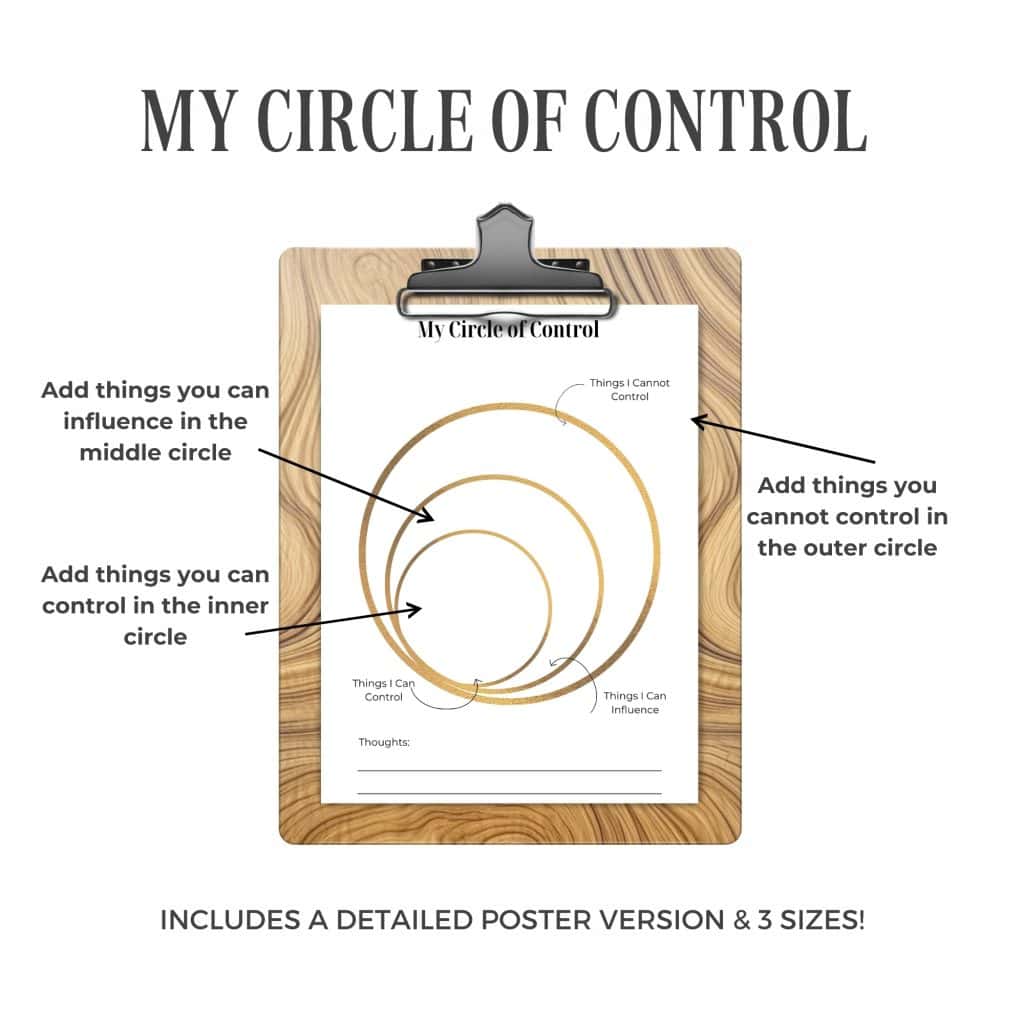
The Circle of Control
A great exercise to support with worry and anxiety. This calming, printable Circle of Control worksheet and poster. Perfect for journaling, therapy sessions, coaching, classrooms, or personal reflection. This tool helps you visually separate what’s within your control, what you can influence, and what’s outside of your control.
What’s Included:
- Printable Circle of Control worksheet (blank + example version)
- Poster version with pre-filled examples (High Res PDF)
- Sizes: A3, A4, and US Letter – Perfect as worksheets or as posters!
Visit the Quietly Conquer Store for a bigger selection of mental health, therapy and productivity tools.
Cognitive Grounding Techniques
Flipping your brain back into cognitive thinking is a great way to bring your thoughts back into a safe space. When worries or anxiety are spiralling, you lose the ability to think clearly, unable to think logically about situations. When you reactivate your cognitive thought process, you are shifting away from the emotional response. Cognitive activities are also helpful distraction techniques, and can be done quickly and silently in your own head.
1. Count Backwards – Start at 100 and count backwards in 7’s or 3’s. The mental effort it takes to do this is often enough to interrupt the current panic or worry, while not being a stressful task to complete. You may find you only need to count down some of the way before you feel significantly calmer.
As you count, focus on slowing your breath at the same time, releasing any tension you are holding in your body. If you do find starting at 100 too challenging, start smaller and repeat, focusing on the numbers and slowing down your breath.
2. Name 5 things – Name 5 things around you, and in your head or quietly out loud, briefly explain what they are and what they are used for/do. Keep repeating until you feel noticeably calmer.
3. Recite Something Familiar – Repeat something that you know well. It could be the words to a song, a poem, a recipe, or a story. The familiarity of the song/poem/recipe/story can give a little comfort in itself, but the focus needed to remember can be enough of a distraction as you think of the correct words or themes.
Journaling
If you have the time and space, journaling can be an extremely effective grounding technique. While it’s less “on-the-go”, it’s something that can help both calm you, and if time is on your side, it can help you understand and process the situation.
You could write down the thought that may be on repeat, then ask yourself, “Is this a fact, fear or assumption?” Or, “Is this something I can control, influence, or is it out of my control?” These CBT-based prompts help you step back from the emotion and take a more logical look at what you’re experiencing.
If you only have a few minutes, using a few simple prompts like:
- “Right now I notice…”
- “In my body I feel…”
- “How realistic is my worry?”
- “How can I bring my mind to a safer place?”
- “What feels heavy, and what feels okay?”
If you have more time, you could explore what happened, look at any potential triggers, and consider how you could change your response if it happens again.
Free-writing is also perfectly fine, just using the space to write, doodle or draw can help shift your attention, and re-regulate your system.
There are some other things that you can do to help during stressful moments. Finding what works for you will always be what matters. Sometimes one way won’t be enough, so looking at other methods can be helpful.
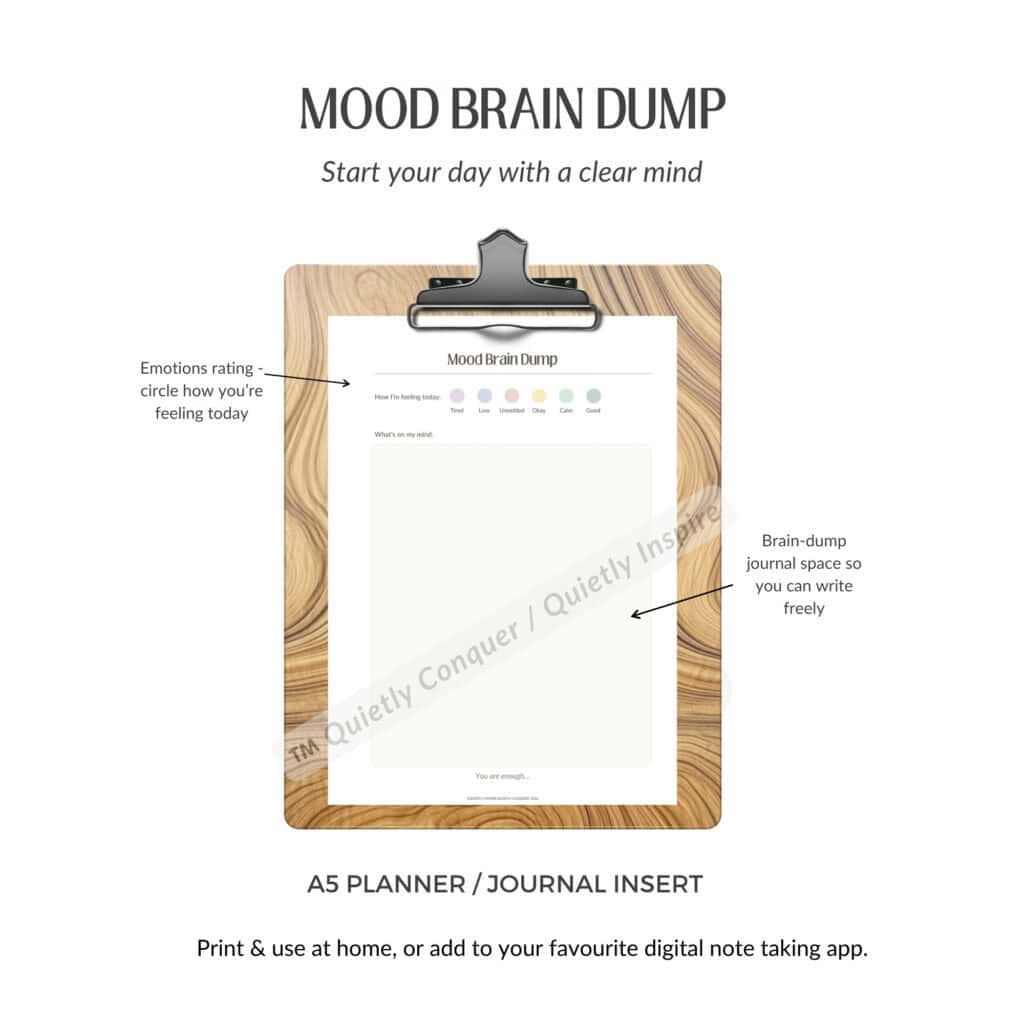
Mental Health Mood Dump
A5 Mood Brain Dump. 2 Versions (Lined & Plain). The perfect addition to your journal or planner.
Create space for your thoughts and check in with how you’re really feeling with this minimalist, printable mental health brain dump journal or planner insert.
It’s a simple, gentle tool designed to help you or your clients empty their mind, name their mood, and release what’s been building up.
Other Grounding Techniques
Other Ideas:
- Personal Comfort – If you can, get into something cosy, in your safe space.
- Listen to an audiobook or podcast
- Do some housework to shift the energy and distract your focus
- Use affirmations like: “I am safe”, “I am strong, and I am grounded”, “I know this will pass”, “I choose to focus on what I can control, and let go of what I cannot”
- Read something backwards, letter by letter, for a few minutes
- Pick up an object, study it and describe it in detail
- Clench your fists, hold briefly, then release.
- Imagine describing what a dog (or other object) looks like to someone who has never seen one before
Tools, Resources & Support
Here are a few tools and resources I recommend; they may be helpful for mental wellness, productivity or small business growth:
Mood Brain Dump – Create space for your thoughts and check in with how you’re really feeling with this A5 minimalist, printable mental health brain dump journal or planner insert. Use digitally with GoodNotes, or as part of your daily journal.
Etsy – Are you ready to create your own online store? Etsy is a brilliant shopping platform that’s used by millions. Setting up your store is simple, and when you sign up with this link, we both get 40 free listings!
Sellers Society – For those wanting to build a successful online store. A brilliant membership, affordable and packed full of value. Weekly shop audits, challenges, tools to get you started and more! Lauren is great and has created a lovely community.
Pacing Planner – This printable digital pacing planner includes energy awareness activities, a task (brain) dump page, a daily planner page, & 3 sizes (A5, A4, US Letter). Designed to help you manage your daily routine and achieve your goals without burning out.
Time and Energy Audit – This free printable helps you discover where your time really goes with this free time audit worksheet. Use the energy rating scale to create a more balanced week. Includes time blocking schedules you can use as a printable or with a digital note-taking app.
Final Thoughts
Grounding techniques are tools, not cures. The goal isn’t to stop feeling anxious altogether; the goal is to have something to use in the moments when anxiety becomes overwhelming or unhelpful, so that you can create enough of a pause to think more clearly and respond to the situation/threat, rather than react.
Different grounding techniques work for different people, and the same person might find different things helpful on different days. If you can, try a few different grounding techniques and notice what feels most effective for you. It can help to keep a note of one or two that you want to remember.
If you work with a therapist or counsellor, these grounding techniques can complement that work well, particularly if you discuss which ones fit with the approach you’re taking together. They’re not a replacement for therapeutic support, but they’re a useful part.
Remember that there’s no right or wrong way with this; ease into it without pressure, and trust that by gently calming your nervous system through slowing your breath, distraction and refocusing your attention, this moment will pass for you.
Do you have a favourite Grounding Technique that’s your go-to? I’d love to hear from you in the comments below
Are you a therapist, coach, or educator who wants to join a community where you can get psychology-informed tools & resources? The Quiet Creator Community is opening soon! Join the waitlist today. Learn how to create content to enhance your brand and grow your audience ethically and professionally.
The Quiet Creator is the space you need if you’re a therapist, counsellor, coach or educator who wants to offer more.
It’s where you learn how to share your expertise through blogs, therapy-style worksheets, and digital products to sell.
You’ll learn practical skills (writing, design, content creation, digital products) so you can use your own skills, experience, and expertise to reach a wider audience. It includes monthly challenges, Canva templates, lessons, guidance, a community doing it alongside you, and much more!
The focus is on working in a calm, intentional way and learning to work at your own pace to achieve your goals.
If this post helped or you enjoyed reading it, please share one of the images below as it really helps my blog – Thank You!
Meet Lynsey

Hey there! I’m Lynsey, a counsellor, coach, and tutor for women who want to create change but feel lost, uncertain, and exhausted. With over 9 years’ experience training, running businesses, and over a decade as a tutor and adult trainer, I’ve learned the value of a gentle, intentional approach to work and life that energises you without draining your energy.
I’ve lived with ME/CFS since 2011, and since then re-trained as a counsellor, and achieved a distinction for my Masters in Counselling and Psychotherapy Practice; all while running 4 businesses!
How? Improving your mindset, finding acceptance in yourself, and developing a gentle, but solution-focused approach to achieving goals is key. It’s not about how fast you move, but about finding your own pace and trusting that you can achieve your goals in your own way, one step at a time.
If you’d like to know more about working with me, you can email me at info@quietlyconquer.com or find me on socials (links in the menu)
Have you seen my online store Quietly Conquer – Find DFY templates, downloads and more!