How to Organise Your Goals (So You Actually Achieve Them)

How to Organise Your Goals
Do you ever feel like your goals are mixed up, floating around in your head, half-formed and overwhelming your brain? Maybe you’ve got a notebook full of ideas, Post-it notes scattered everywhere, or piles of unfinished to-do lists that you’ve abandoned as life quietly took over.
If yes, know that you’re not alone. Many people have goals and amazing ideas, but not everyone has the time, energy, knowledge or systems to make those goals feel achievable.
Making space to organise your goals isn’t about creating rigid plans or pretty, colour-coded spreadsheets (Although if you love a pretty spreadsheet – go for it!). It’s about bringing clarity to what matters, giving your ideas a foundation, and building on them in a calm, focused way, even when you’re exhausted, overstretched, or life feels chaotic.
In this post, I’ll walk you through how to organise your goals in a way that feels grounded, adaptable, and doable. It’s especially helpful if you’re managing low energy, live with self-doubt, or you just have too many tabs open in your brain…
*Affiliate Disclosure: Some links in this post may contain affiliate links. If you purchase something via the link, I may receive a small commission. This doesn’t affect the price you pay.
If you have any questions, reach out for a chat at info@quietlyconquer.com or check out my other blogs
Table of Contents
Why it’s Important to Organise Your Goals
When your goals are unorganised, it can impact your energy as you try to remember what you need to do, rather than have clarity on what’s been achieved, how you’re progressing, and what’s next.
This can make you feel overwhelmed, impacting your confidence and focus. You may miss steps or end up doing things that don’t really need your attention right now. Indecision can set in as you try to figure out your next steps instead of having a clear plan for what you need to focus on.
Whether you’re running a business, studying, managing a home, or working towards personal growth goals, clear goal organisation helps you:
- Feel less overwhelmed
- Stay focused on what truly matters
- Track progress (even small wins!)
- Be more intentional with your time
- Create consistency (even on low-energy days).
Making time to organise your goals gives you space to breathe, reflect, and feel confident in the actions you take. Let’s look at 7 simple steps you can take to organise your goals to create a sustainable, balanced approach.
Step 1: Start With a Brain Dump
Before you organise your goals, you need to see the full picture and understand exactly where you’re at right now and what you need to do to get to where you want to be. Start by brain-dumping everything in your head related to the goals you want to achieve. You can use paper, a notes app, or a journaling tool.
Things you could write down:
- Ideas you’ve had for months but haven’t actioned yet
- Goals you’ve started but stopped
- Things you want to do “someday”
- Projects that feel important (even if you’re not sure why)
- Goals that feel out of reach right now, but you want to keep in mind
Offload everything – but don’t begin sorting them yet; this step is about clearing your mental clutter.
Tip: If this feels overwhelming, break it down by area: Personal, Business, Wellness, Relationships, etc. You can use multiple pages to help keep them separated if that helps your brain.
Step 2: Clarify Your ‘Why’
Now you’ve got a list; ask yourself: Why do I want to do this? As you read each goal, ask yourself that question. When you are clear on the why behind a goal, it helps you connect on a deeper level and understand whether it’s something you truly want to work toward.
Some goals will stick because they’re aligned with your values or deeper vision – even if you’re not too sure about the end destination yet. Other goals might simply be there out of pressure, comparison, or expectations that you had previously.
For each goal, reflect:
- Is this something I truly want?
- Will this move me closer to the life I want to build?
- Does this suit my current energy, capacity, or situation?
If you have any “no” responses, trust yourself to let go of anything that no longer feels aligned. If you’re not ready to fully let them go, choose to pause and add them to the “someday” pile. This is another way to simplify and declutter all those goals you’ve had floating around and taking up space in your mind.
Step 3: Categorise Your Goals
The next step is to group your goals so they feel less chaotic. This will create a clear overview of the different goals you want to work towards.
For example, you could try categories like these:
- Life Goals: Health, Home, Relationships, Career, Personal Growth
- Short, Medium, Long-Term Goals: This week, month, year, 3-5 years
- Energy Level: Low-effort goals, high energy / intense goals
Step 4: Break Goals Into Projects or Habits
Big goals can feel intimidating because they’re too vague or too large. Understanding what a goal entails will help you categorise and break it down into smaller, achievable steps.
Consider:
Is it a project with a clear start/end and multiple steps? If yes, outline 3-5 smaller steps. Keep it as simple as possible.
Is it a habit – something you’ll repeat regularly? If yes, think about the frequency (daily/weekly habit?). What does the smallest version of this habit look like?
For example:
Goal: Write and publish a KDP Journal
Project steps:
1. Outline the client transformation
2. Draft content
3. Request feedback
4. Format and publish on Amazon
5. Share with your audience
Or:
Goal: Improve self-confidence so I can show up confidently
Habit: 5-minute reflective journaling each day
The first example highlights how, by breaking the goal into only 5 steps, you can visualise how you’ll achieve the change/goal you’re working towards.
Once you begin working on them and create plans, you can break the initial 3-5 steps into even smaller ones, clarifying all the small steps needed to achieve them.
Step 5: Prioritise Goals
Remember that you don’t have to do everything at once. I totally get how exciting new goals are, and how hard it can be to choose which one to focus on first. But if you don’t choose to prioritise, you’ll probably stay stuck and keep feeling overwhelmed.
Choose 1 – 3 core goals to focus on for the next month or quarter. This removes any unnecessary pressure and allows space for creativity and life in between!
Choose the goals that:
Feel most meaningful right now, and fit with your current energy levels. Remember, you can review and adapt goals as you go along. If you’re currently struggling with energy, keep them minimal. If your energy increases over the coming days or weeks, revisit them and see if you can add more.
It’s also a good idea to choose the goals that will support your wellbeing or support your longer-term goals – whether these are business/study or personal. Notice any you feel resistance to committing to. What’s going on there? Is it because they are more challenging/boring/or something else?
All the other goals you have written down can go on a ‘Later’ or ‘Not Now’ list. This way you’re not saying no forever; you’re just creating space for what matters and what needs your attention right now.
Gentle Productivity Tip:
Create a “Bare Minimum Plan” for low-energy days. This is a short list of things that still move your goals forward a little, for example, 10-minute tasks, prep tasks, research, or a few minutes of reflective journaling.
Step 6: Choose an Organisation System
Step 6 is about giving your goals a place in your office/computer that’s easy to access, quick and simple to update, and something you’ll use regularly.
Here are a few ideas:
- A dedicated notebook, planner or journal
- A Notion Dashboard (my absolute favourite, and great for visual thinkers and for ordering multiple projects in one space)
- Trello / Airtable / Evernote – All great for organising multiple projects.
- Create a mind map – one for each goal you’re focusing on to keep it simple and uncluttered.
What matters most is using a tool you can be consistent with and find easy to use. Choose what suits your brain and working style best. Some may find handwritten notes the best for them, while others get lost in piles of unstructured pages.
Step 7: Reflect and Adjust Often
Goals are ever-moving and ever-changing. They’re never static; they should evolve with you as you navigate tasks, take steps forward and manage any challenges along the way. While the overall goal may stay much the same in many cases, the smaller goals are likely to change quite often.
You may also get halfway along and just not feel it anymore. You may realise that you want a different goal, so you pivot or change direction completely. That’s why regular reviews are so important. It’s much better to identify issues sooner rather than later, after you’ve spent a lot of time working toward something you no longer want.
Set regular check-in review sessions (weekly, monthly, or quarterly). Review your progress and ask yourself:
- What’s working well?
- What feels off or isn’t working so well?
- Does the direction I’m going in still feel right for me?
- What adjustments/pivots do I need to make?
We have a selection of planning tools in the store – take a look at this project planner.
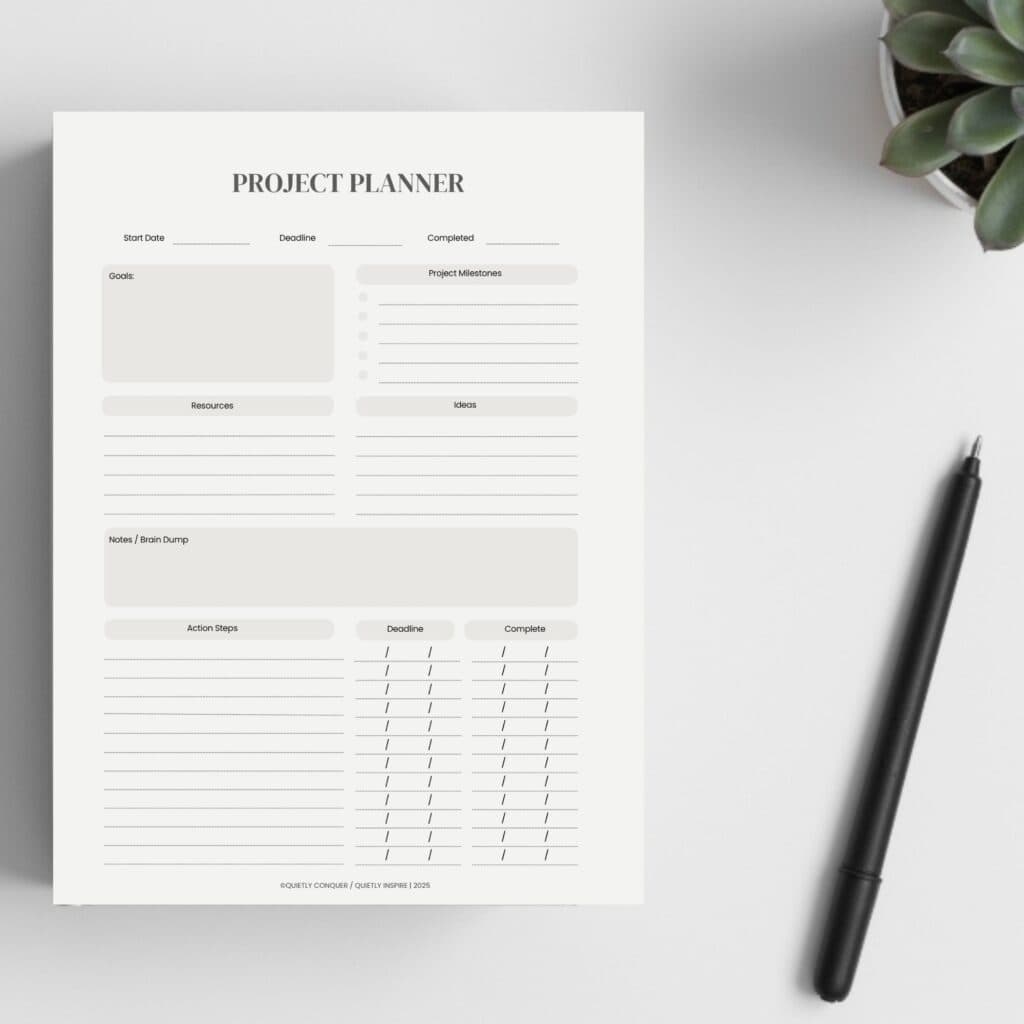
Project Planner
This printable project planner comes in 2 versions – structured & minimalist.
Track your projects with deadlines and action steps. Add it to your current planner, or use it as a desk buddy to keep you focused as you work toward your goals.
Tools, Resources & Support
Take a look at these tools & resources that will help you with your intentional planning, seasonal goals and personal growth:
Project Planner Printables – Designed to help you plan effectively for your project, giving you a bird’s-eye view & clear breakdown of tasks. The simple, minimalist design helps to keep you focused and stay organised as you work towards your goals
90-Day Planner – This printable 90-Day planner is the perfect companion for you as you set your focus for the next 3 months. Use it every 90 days to help build consistent habits and achieve your goals with ease. With a focus on intentional planning and moving forward at your own space, it’s the perfect companion to see you through to the end of the year.
Canva Pro – Upgrade your content design with Canva Pro. Explore the enhanced features available in Pro. Grab your free trial here.
Etsy – Are you ready to create your own online store? Etsy is a brilliant shopping platform that’s used by millions. Setting up your store is simple, and when you sign up with this link, we both get 40 free listings!
Final Thoughts
Achieving goals doesn’t need to be stressful or overwhelming. Yes, they can be challenging at times, and this is why taking the time to organise your goals will help you cut through the noise and create steady, sustainable progress.
When my own mind is full of ideas, half-finished projects and goals for everything, I crash quite quickly. Since I began working this way, I’ve found that I have much more energy, and I’m able to create a more balanced way of working and living.
Think about the relief and lightness you feel when you organise your home and have a clear-out. Taking the time to organise your goals provides that same sense of release as you create space in your mind to focus on what you want to. No more feeling like you’re chasing your tail!
How will you organise your goals? Are there certain goals that you know you’ve been holding on to that need to be let go of?
I’d love to hear from you – Share below ⬇️
Coming Soon – The Quiet Creator – A community on Skool dedicated to creating psych-informed content and products for educators, therapists and coaches. Here’s the link to the community. Request to join, and I will accept you once the group is ready!.
If this post helped or you enjoyed reading it, please share one of the images below as it really helps my blog – Thank You!
Meet Lynsey

Hey there! I’m Lynsey, a counsellor, coach, and tutor for women who want to create change but feel lost, uncertain, and exhausted. With over 9 years’ experience training, running businesses, and over a decade as a tutor and adult trainer, I’ve learned the value of a gentle, intentional approach to work and life that energises you without draining your energy.
I’ve lived with ME/CFS since 2011, and since then re-trained as a counsellor, and achieved a distinction for my Masters in Counselling and Psychotherapy Practice; all while running 4 businesses!
How? Improving your mindset, finding acceptance in yourself, and developing a gentle, but solution-focused approach to achieving goals is key. It’s not about how fast you move, but about finding your own pace and trusting that you can achieve your goals in your own way, one step at a time.
If you’d like to know more about working with me, you can email me at info@quietlyconquer.com or find me on socials (links in the menu)
Have you seen my online store Quietly Conquer – Find DFY templates, downloads and more!