4 Time Management Hacks

In this blog we look at 4 time management hacks for busy mums, entrepreneurs, therapists, businesses outside of the 9 to 5, and people with low energy.
Time management is a funny thing – time is time – and your relationship with it can make a huge difference in how you approach your work and how you use the time that you have available.
We all have a finite number of hours in the day. We all have a limited number of hours that we can work on our businesses, our goals, our projects, whatever it is we are working on. When I discuss time management, I want to be clear – time can’t be stretched but what you can do is make the most out of the time that you do have.
That isn’t to say you’ve got to work at 100 miles an hour at every point that you’re sat at your desk, instead you have to learn how to work smartly in the time that you have. It’s all about learning how to work for you in a way that works best for you.
What we cover:
- How to improve your relationship with time and time management
- Working with your energy
- Time Auditing
- Time Blocking
- Active Planning
*Affiliate Disclosure: Some links in this post may contain affiliate links. If you purchase something via the link, I may receive a small commission. This doesn't affect the price you pay.
If you have any questions, reach out for a chat [email protected] or check out my other blogs
Table of Contents
Time Management
There are a few different aspects to time management – knowing when you work best & understanding the way that you work best. Time management isn't about trying to control time, it's about using it to make things work for you. The 4 tips shared are designed to keep things simple, but have the biggest impact.
Tip 1: Working With Your Energy
Awareness of your own ebbs and flows. This has been key for me in becoming more productive without working harder. Personally, I have more energy and focus in the morning, so what I have learned is, if I use too much energy, or spend too much time on the small tasks; for example opening emails and doing little fiddly bits just to warm me up – the chances are my brain will give up before I get to the stuff that really needs doing.
For others, it can take a while to warm up in the morning so late morning or early afternoon might be your most focus time.
When do you feel most energised and focused? Knowing this will help you with planning a day that works. If you're not a morning person – planning high concentration, complex, or high energy level activities will mean ineffective work and output.
For example, if you’re affected by your monthly cycles, health issues, caring for young children, family commitments, or other jobs, some days are harder than others, especially when there's lots to juggle.
My energy ebbs and flows significantly due to my chronic illness (and age). This is intensified with hormone fluctuations, acute illnesses, or work demands. When I stopped cramming high energy activities around these times, I was able to keep up a consistent level of productivity.
This means some days I work less, but I am still able to gently move things forward without wasting my energy or burning myself out. When you’re not energised, or you're finding the work challenging – but you keep forcing it – it can end up taking hours to finish a task that would normally take you only 20 or 30 minutes!
When do you notice your energy fluctuates? What adaptations do you have in place during these times?
Tip 2: Time Auditing
The second time management tip is to get crystal clear on where your time is actually going. It's easy to over or under estimate how long tasks will take, which if not recognised can have a knock-on impact to the rest of your day.
Generally when you plan your month, week, or year, you estimate how much time you will be able to give to each task. This is how you add it into your schedule & make plans around it.
But, estimating time spent is kind of the same as when you're trying to lose weight, but instead of measuring or tracking things, you guess the calories you’re eating. Often, when you look a bit deeper, it’s obvious you’ve been eating a few extra calories than what you originally thought…
Time auditing is a brilliant tool for getting a more accurate overview. I absolutely love doing this myself, especially when starting a new project. It will enable you to get clear on exactly where your time is going, and how long tasks are actually taking you, making your monthly, weekly, and daily plans much more accurate and workable.
Sometimes tasks take longer than you estimated, they may be more difficult, or more complex with lots of smaller steps.
To plan and work effectively, you need to make sure that when you're plugging the tasks for the day into your schedule, or planning for the next week or month, you’re being realistic about what time you have to dedicate to the work. It helps avoid overwhelm and feeling like you're behind all of the time!
I suggest doing this over a week, but a few days would also be good enough. To do this, track everything you do over 3 – 7 days. Keep it next to you so that you can add it into the tracker once complete. Make a note of how long each task has taken you, as well as rating the energy impact of each task.
Colour-coding this gives you a clear overview of your current work and energy output, making it easier to see where changes need to be made.
Ask yourself:
- Was it a high energy (red) level, where your energy was spent after completing it?
- Was it a medium (orange) level energy task that meant you needed a little bit of time afterwards?
- Or, was it a low energy (green) task that you felt okay with, and you were still ready and able to move onto the next thing?
Understanding the impact each task has upon your energy will help you plan more effectively and improve your time management approach.
When it comes to planning ahead, you can make sure that high energy tasks aren't cramped together, this gives more balance, and enables you to introduce breaks to manage higher energy working sessions.
Free Time Management Tool:
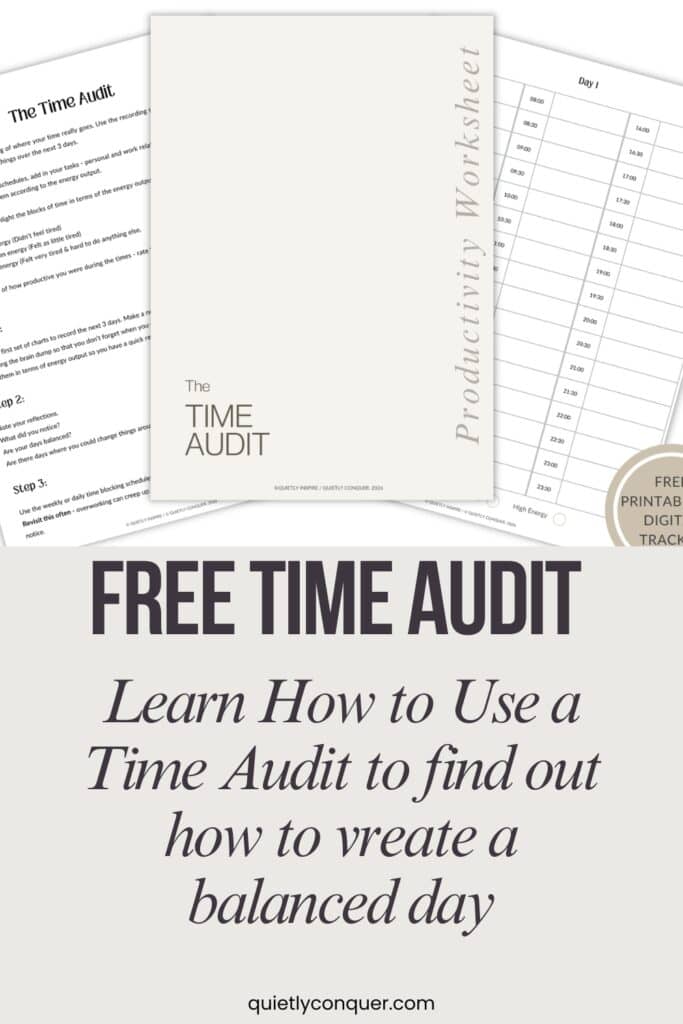
I have created a free time audit workbook tracker. In it you can use the first 3 tracking pages to reflect on your current schedule and working practices. There is space to reflect and create a detailed overview of everything you need to focus on over the week. Then there are 7 time-blocking daily pages, plus a weekly time-blocking schedule to help you get into a new, energy-friendly routine.
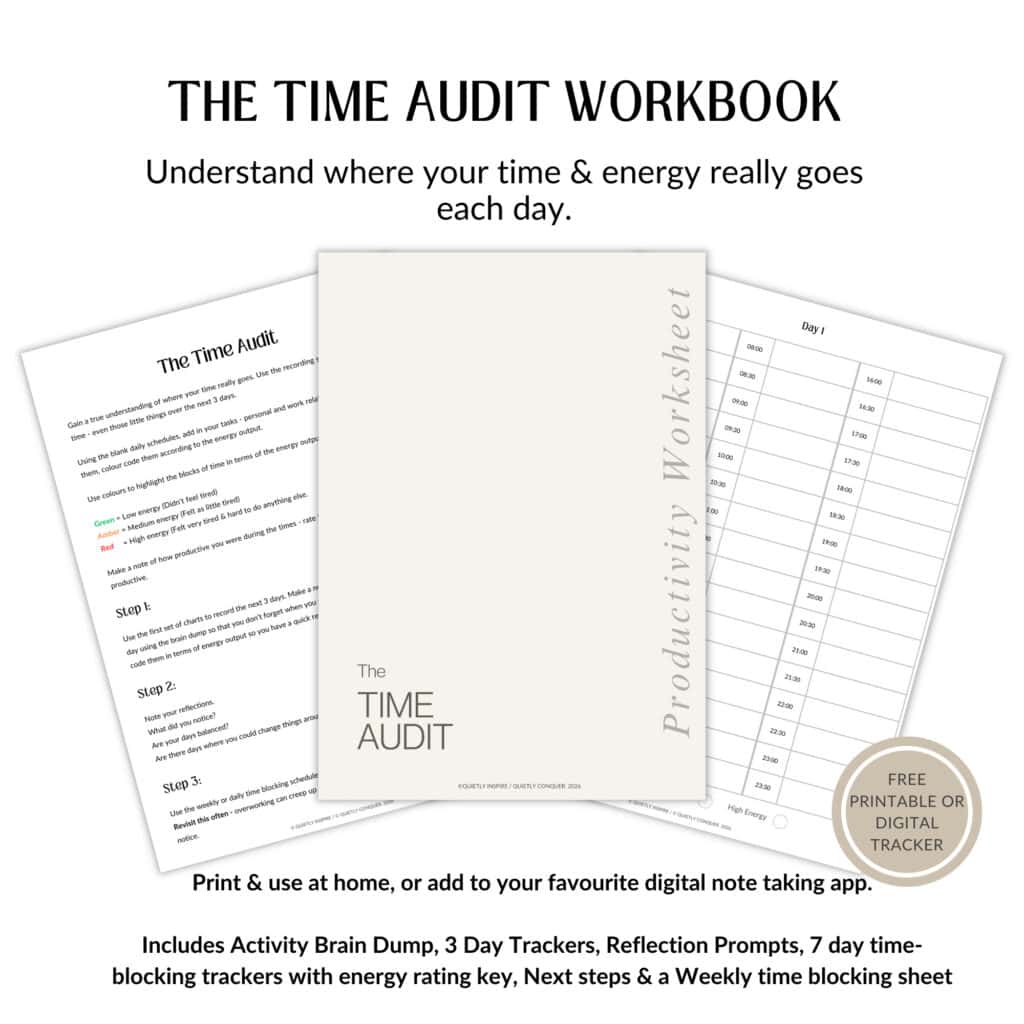
The Time Audit workbook!
Discover where your time is actually spent!
Use this time management tool to increase productivity & lessen procrastination.
Tip 3: Time Blocking
I briefly mentioned time blocking before. This is where you dedicate a certain amount of time (whether it’s 15, 30, 45, or 60+ minutes), to a task.
It's an effective method if you only have short amount of time to focus on your project or business goals. It's also helpful if you're a procrastinator or a perfectionist, and you know that time easily disappears on things that probably need a lot less time (e.g., the fun stuff!).
When you time block and have it in your calendar, you can see exactly where your time is going to be focused for that shorter period of time. No decision fatigue, no distractions in that specific timed session.
If you're someone who gets easily distracted or faces creators or writers block a lot, you already know what you're going to be focusing on, and it's not an overwhelming stretch of time to fill. You are clear on what you will be doing, and the shorter sessions can feel more like a challenge – which can be really motivating!
Tip 4: Use an Interactive Plan
Creating a plan is all good – but it needs to be more than simply writing it out on a Sunday or Monday, and then just glancing at it briefly over the week. You need to use it. It needs to be something that grows alongside you and your projects. It needs to be messy and seen as your faithful assistant!
Initially your plan should act like a roadmap, giving directions of steps you need to follow to achieve your goal. It's where you break down the goal into smaller, and more manageable tasks that you can tackle each day.
Your plan needs to be your best friend – it needs to be interactive & by your side!
Having a plan that you use everyday means you'll always know what you have done, what's coming up, the time you have, the tools you need, and what your next steps are. It doesn't have to be a strict timetable, just a clear reflection of your goals, your progress, and the tasks outstanding.
A clear interactive plan with a step-by-step pathway like this takes away any indecision and confusion which is particularly useful if you’ve only got 15/30 minutes at a time to work on things. You can just sit down, look at where you’re at on your list of tasks, and pick it up at that point.
Each day note what you've accomplished, any reflections or pivots you've made, and repeat the next time you work. This approach is very handy for busy people, juggling other things, or low energy, who can't dedicate tonnes of time each day to work on things.
Having something that can help keep you on track, and save you time when you sit down to work is a great addition to your system.
The magic is in making sure that your plan is interactive, and not something that’s just written in at the start of the week and then not looked at until the next week. It needs to be your blueprint, and your business hub. it's where you note any progress, changes, successes, obstacles, and solutions. It’s interactive, and it’s by your side.
Whether you use a paper planner, or an online system, working with your planner this way will act like a brain dump – which means you won't have to try and store and remember multiple different things. A clearer mind makes life so much easier!
I would love to hear your thoughts on time management – please share in the comments below!
Tools, Resources & Support
Take a look at these tools and resources that will help you with your goals and personal growth:
Pacing Planner – A printable digital pacing planner includes energy awareness activities, a task (brain) dump page, daily planner page, & 3 sizes (A5, A4, US Letter). Designed to help you manage your daily routine and achieve your goals without burning out.
Impact Stationery – Have you ever dreamed of creating your own high-end stationery products? Laura has an amazing course & community designed to help you created printed products that you can market on Amazon, or your own website. It's different to KDP in that they're not print on demand, and the quality of products are incredible.
Etsy – Are you ready to create your own online store? Etsy is a brilliant shopping platform that's used by millions. Setting up your store is simple, and when you sign up with this link we both get 40 free listings!
Time Audit – Gain a clear understanding of exactly where your time and your energy is spent. Highly recommend doing this if you're planning to focus on increased productivity.
Canva Pro – Upgrade your content design with Canva Pro. Explore the enhanced features available in Pro. Grab your free trial here.!
Task Batching – I created this task batching / brain dump workbook to help you get to grips with batching tasks. You can also read the post here for further info!
Pinterest Guide – If you're looking to get into Pinterest, I highly recommend Amy's free guide and Pinterest course. It's up-to-date for 2026 & she also has a brilliant course for only $67 that's updated frequently. (I have a 50% discount on the course using this link SEO and the code RANK)
Final Thoughts
TIme management is something that is personal to you. As humans with different experiences, lives, commitments and goals, there isn't a one-size-fits-all approach to it.
For me, time management is avout finding a way to work with time rather than try to control it. I am aware of my own limitations, and how to pace things on days I have higher energy.
Understanding that there are different ways to manage my daily and weekly schedules has been key for me in my own work.
Whatever your preferred time management technique is, as long as it supports your progress as well as a balanced life- it doesn't need to be perfect.
If this post helped or you enjoyed reading it, please share one of the images below as it really helps my blog – Thank You!
Meet Lynsey

Hey there! I'm Lynsey, a counsellor, coach and mentor for women who want to create change, but are feeling lost, uncertain and exhausted. With over 7 years’ experience of training, running businesses, and over a decade as a tutor and adult trainer, I've learned the value of a gentle and intentional approach to work and life that energises you without draining all of your energy.
I've lived with ME/CFS since 2011, and since then re-trained as a counsellor, and achieved a distinction for my Masters in Counselling and Psychotherapy Practice; all while running 4 businesses!
How? Improving your mindset, finding acceptance in yourself, and developing a gentle, but solution-focused approach to achieving goals is key. Knowing that it's not about how fast you move, but finding your own pace and trusting that you can achieve your goals in your own way, one step at a time.
If you'd like to know more about working with me, you can email [email protected] or find me on socials (links in the menu)
Have you seen my online store Quietly Conquer – Find DFY templates, downloads and more!